Mesa+ Rubric Purpose
What is the Mesa+ Rubric?
The Mesa+ Rubric is a research-supported framework designed to guide the development and continuous improvement of online and hybrid courses. Organized around evidence-based instructional practices, the rubric provides faculty with practical guidance for creating engaging, accessible, and learner-centered learning experiences that align with current research and federal distance education expectations.
Unlike an evaluation instrument, the Mesa+ Rubric is intended to support professional growth through reflection, self-assessment, peer collaboration, and continuous course improvement. Whether developing a new course or refreshing an existing one, faculty can use the rubric to make meaningful, incremental improvements over time.
Rubric Structure Description
How is the Mesa+ Rubric organized?
The Mesa+ Rubric is organized into seven standards, each representing a key component of quality online and hybrid course design. Together, these standards provide a comprehensive framework for designing engaging, accessible, and learner-centered online learning experiences.
Standards
Each standard begins with an overview page that introduces the standard, explains its purpose, and provides a brief video overview. The overview page also includes links to the associated criteria within that standard.
Criteria
Within each standard are individual criterion pages that provide detailed guidance for implementing evidence-based teaching practices. Each criterion page follows a consistent format to make the rubric easy to navigate and apply.
Explanation of Standards Page Layout
Explore the page descriptors below to learn more about each component of a criterion page.
Each criterion is assigned one of the following priority levels to help faculty focus their course improvement efforts:
Essential → Very Important → Important
An introduction to the instructional practice.
The research or rationale behind the criterion.
Characteristics of effective implementation.
Practical strategies for incorporating the practice into your course.
Practical examples that demonstrate a progression from Building → Strengthening → Transforming.
Criteria Ranking Explanation
What do the priority levels mean?
Each criterion is assigned a priority level to help faculty identify where to begin and focus their course improvement efforts. The priority level reflects the relative importance of the criterion in supporting high-quality online and hybrid course design and is categorized as Essential, Very Important, or Important.
Essential
Core practices that provide the foundation for student success, accessibility, compliance, and effective online course design.
Very Important
Practices that strengthen course quality, learner engagement, organization, and instructional effectiveness.
Important
Practices that further enrich course quality and support continuous improvement beyond the foundational expectations.
RSI Explanation
What is Regular and Substantive Interaction (RSI)?
Several criteria within the Mesa+ Rubric incorporate Regular and Substantive Interaction (RSI) to promote meaningful instructor presence and comply with federal distance education regulations. RSI refers to meaningful, instructor-initiated interactions that occur on a regular and predictable basis and are directly related to student learning. Examples include facilitating course discussions, providing timely and personalized feedback, answering content-related questions, monitoring student progress, and offering instructional guidance throughout the learning process.
Rather than presenting RSI as a separate standard, the Mesa+ Rubric integrates these practices throughout multiple criteria where instructor interaction naturally supports learning. As faculty review the rubric, they will identify opportunities to strengthen instructor presence, communication, feedback, and learner engagement while supporting federal expectations for distance education.
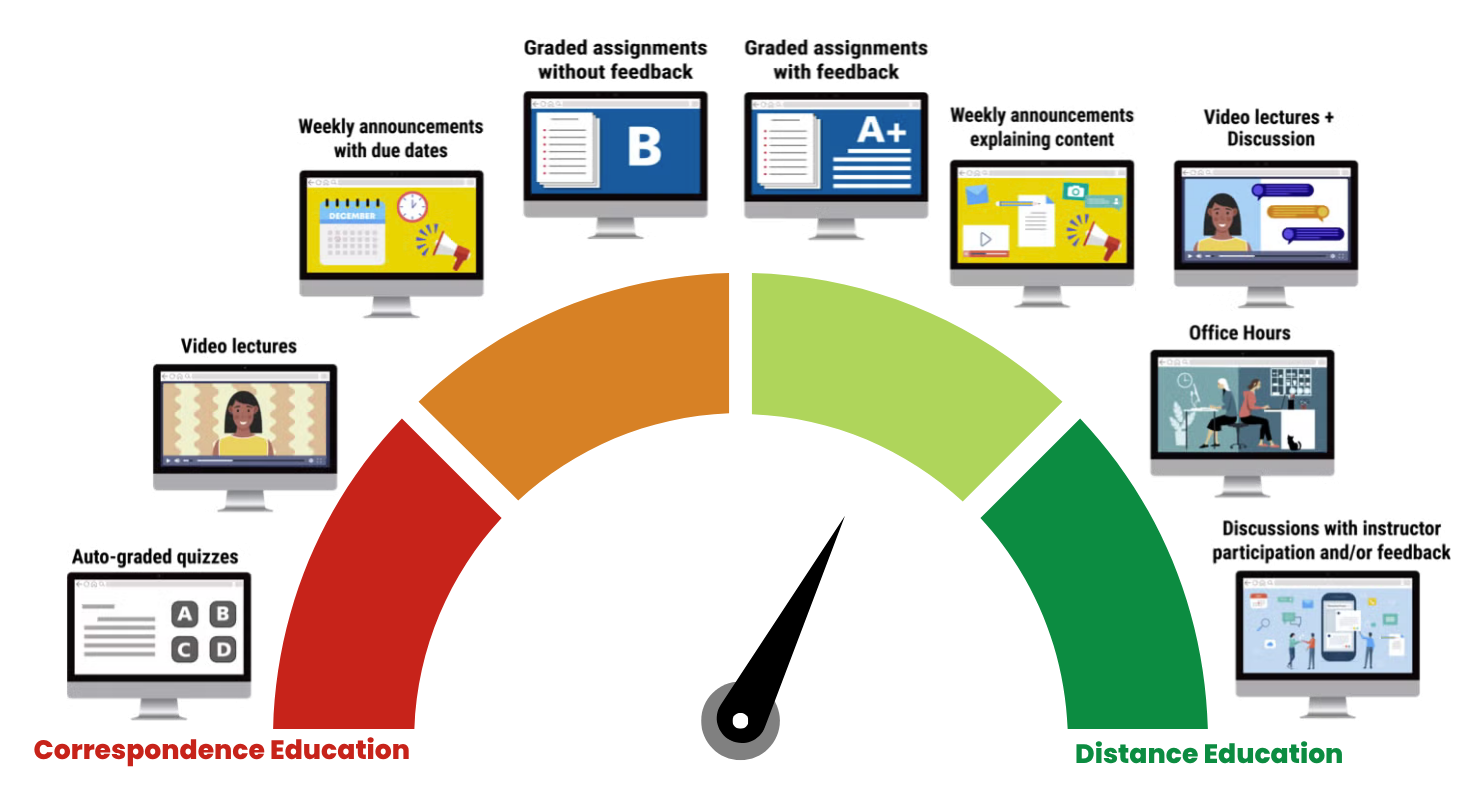
Accessible Extended Description
Overview: A semi-circular color spectrum gauge mapping learning modalities according to federal Regular and Substantive Interaction (RSI) guidelines. The arch transitions from non-compliant Correspondence Education on the far left to fully compliant Distance Education on the far right.
Left Side — Correspondence Education (Red & Orange / Low to No RSI):
- Red Segment (Far Left): Represents self-paced, passive learning lacking regular instructor interaction. Computer screens depict static multiple-choice quizzes, auto-graded test forms, and standalone recorded video content without instructor follow-up.
- Orange Segment (Middle Left): Displays basic course organization features, including automated assignment schedules and grade postings (e.g., grades "B" and "A+"), but lacks substantive, personalized direct instruction from the faculty member.
Right Side — Distance Education (Yellow & Green / Meets RSI Requirements):
- Yellow Segment (Middle Right): Displays instructor-initiated interactive elements, such as instructor-led Q&A forums, direct feedback on assignments, and active communication channels between faculty and students.
- Green Segment (Far Right): Demonstrates full RSI compliance through instructor-guided group discussions, real-time interactive lectures, collaborative group activities facilitated by faculty, and multi-device accessible digital learning spaces.
Spectrum Key:
- Bottom-Left (Red Text): "Correspondence Education" (does not meet federal RSI requirements for distance education).
- Bottom-Right (Green Text): "Distance Education" (meets federal RSI requirements through scheduled, instructor-initiated interaction).
Make a Copy of the Rubric
How do I use the Mesa+ Rubric?
The Mesa+ Rubric is designed to be flexible and can be used throughout the course development process. Faculty may use the rubric when designing a new course, revising an existing course, preparing for an online course review, or exploring new instructional strategies. While the rubric can be reviewed from beginning to end, it is equally effective when focusing on individual standards or priority levels.
By making purposeful, incremental improvements over time, faculty can strengthen course quality while creating engaging, accessible, and learner-centered learning experiences.
How do I request a copy?
Request your own copy of the Mesa+ Rubric to reflect on your course design, identify opportunities for improvement, and develop an action plan for enhancing the online learning experience. Use the link below to request a personal copy for your Google Drive.
Mesa+ Rubric is being updated. It will be published soon.
Note: The rubric has Apps Scripts in it, and you will need to select the banner message to activate them.